
Category: Omnichannel AI agent
Omnichannel AI agents for your business
An agent that handles support, books appointments, collects payments, and knows your business across WhatsApp, web, and Instagram, 24/7.
What an omnichannel AI agent is
An omnichannel AI agent is a conversational assistant that operates with the same intelligence and memory across multiple channels (WhatsApp, Instagram, web, email) and is anchored to the business's real knowledge base. It combines a language model with retrieval (RAG) to answer with the customer's documents, policies, and processes, not data from the model's training.
Unlike a traditional rule-based chatbot, the agent understands intent in natural language, keeps context across channels, and routes to the right human when the case requires it. Unlike a generalist assistant (like ChatGPT), the agent operates within an enterprise perimeter: official integrations, private data, Meta's commerce policy, and per-conversation traceability.
Four capabilities, one agent
Support, book, collect, and know. All inside the same conversational flow.
24/7 support on WhatsApp and Instagram
Answers with your real information, escalates to a human only when needed, and operates after hours without hiring a call center.
View 24/7 support caseAppointment booking on WhatsApp
Reservation, automated reminders, rescheduling, and confirmation. No external forms, no jumps to another app.
View booking caseAutomated payment reconciliation
Captures bank notifications (PagoMóvil, Zelle, transfers, USDT) and confirms to the customer without a human in the loop.
View reconciliation caseAutomated collections with context
Systematic follow-up of past-due accounts with adjustable tone and per-customer traceability. Nobody forgets, nobody burns out.
View collections caseAI agent, traditional chatbot, or human call center
Each model fits a different scenario. Here are the practical differences, no jargon.
| Dimension | Omnichannel AI agent | Traditional chatbot | Human call center |
|---|---|---|---|
| Understanding | Natural language, intent, context | Rules and keywords | Full, depending on the agent |
| Knowledge | Business documents (RAG) | Pre-loaded FAQs | Training plus experience |
| Hours of coverage | 24/7 | 24/7 | Limited to shift |
| Scale | Marginal cost near zero per conversation | Good, but rigid answers | Linear cost with volume |
| Human handoff | With full conversation context | No context, cold transfer | Not applicable |
| Meta 2026 compliance | Yes, via certified Tech Provider | Depends on the provider | Not applicable |
Meta 2026 compliance
What changed in WhatsApp and why it matters
Meta restricts the use of generalist AI assistants inside WhatsApp and requires integrated providers to be certified Tech Providers. That category applies to Kharyo: enterprise messaging runs through the official WhatsApp Business Cloud API, in line with the commerce policy and the technical requirements of the program.
For the end customer, that means onboarding without manual paperwork, per-conversation auditability, and the assurance that the number does not depend on unofficial tools. If you want the certification details, they are documented on the Meta Tech Provider page.
Industries that fit
The same agent adapts to each vertical's vocabulary: clinics, real estate, e-commerce, restaurants, agencies, and professional services.
Frequently asked questions
What buyers researching the category most often ask.
What is an omnichannel AI agent?+
An omnichannel AI agent is an assistant that operates with the same intelligence and memory across multiple channels: WhatsApp, Instagram, web, and email. Unlike a traditional decision-tree chatbot, an agent combines a language model with the business's knowledge base (RAG), so it answers with your real information and keeps context across conversations.
How is it different from a traditional chatbot?+
A traditional chatbot follows pre-loaded rules and option menus. An AI agent talks in natural language, understands intent, retrieves information from your documents, and routes to the right human when needed. No "press 1, 2 or 3", no generic answers.
How is it different from a human call center?+
A human call center does not scale after hours, depends on trained staff, and breaks under demand spikes. An AI agent operates 24/7, with marginal cost near zero per additional conversation, and routes to a human only when the case requires it. The intent is not to replace the team: it's to free the team from repetitive queries.
What changed with Meta's new rules for 2026?+
Meta restricts the use of generalist AI assistants inside WhatsApp and requires integrated providers to be certified Tech Providers. Companies operating with a certified provider can keep using enterprise AI agents that comply with Meta's commerce and messaging policies.
Does it work on WhatsApp, Instagram, and web with the same agent?+
Yes. The same agent receives messages from WhatsApp Business, Instagram Direct, and a web widget. The customer's memory is shared: if they write first on WhatsApp and then on Instagram, the agent picks up the context without making them repeat themselves.
Do I need to be a Meta Tech Provider to run it?+
To operate through the WhatsApp Business Cloud API in line with Meta's 2026 rules, yes. Kharyo is certified as a Meta Tech Provider, so the end customer does not need to be: they inherit the official integration when connecting their number.
How long does onboarding take?+
WhatsApp Business integration happens in clicks: the customer connects an existing number or registers a new dedicated one, and Kharyo provisions the Cloud API through Meta's official infrastructure. Loading the knowledge base depends on the volume of business documents.
What if I decide to switch providers?+
Your WhatsApp Business number and your WABA live inside your Meta account. Kharyo runs the technical integration but does not own the number. If you decide to move to another provider, the number stays with you and the migration is coordinated directly with Meta.
More than a web app
Reply to your customers from anywhere
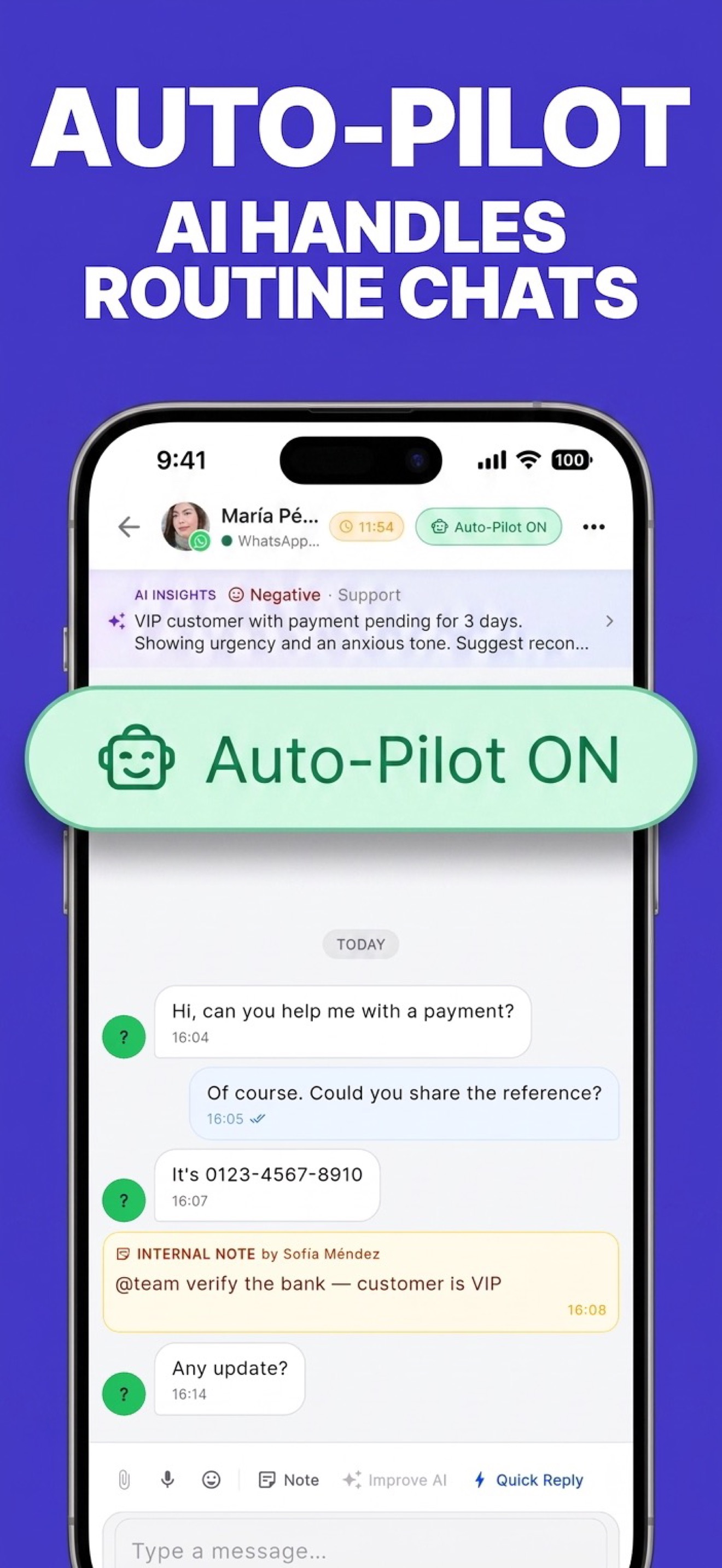
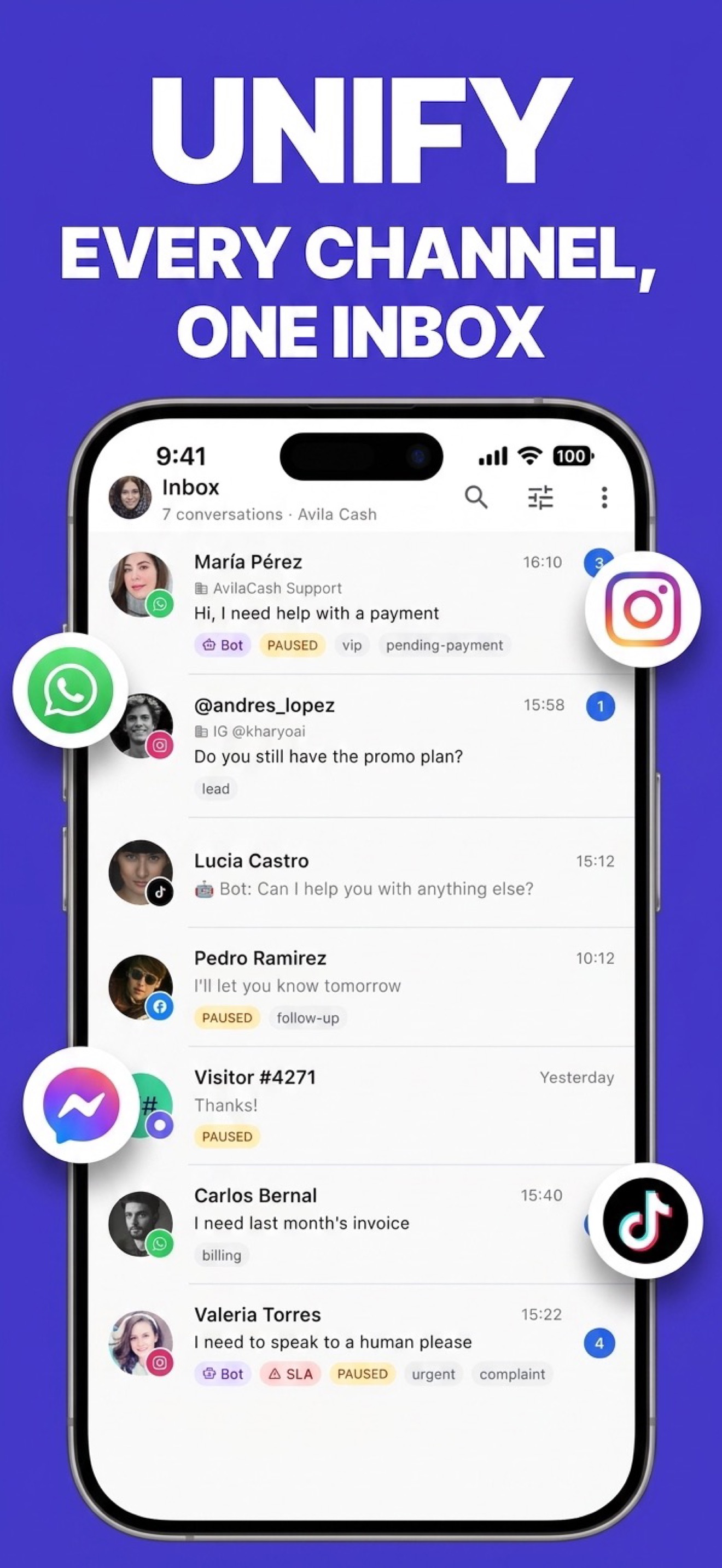
Kharyo Inbox brings the omnichannel inbox to mobile. WhatsApp, Instagram and Messenger in one place, with AI Auto-Pilot that answers for you and notifications that only fire when a customer truly needs you.
Kharyo Inbox · iOS + Android
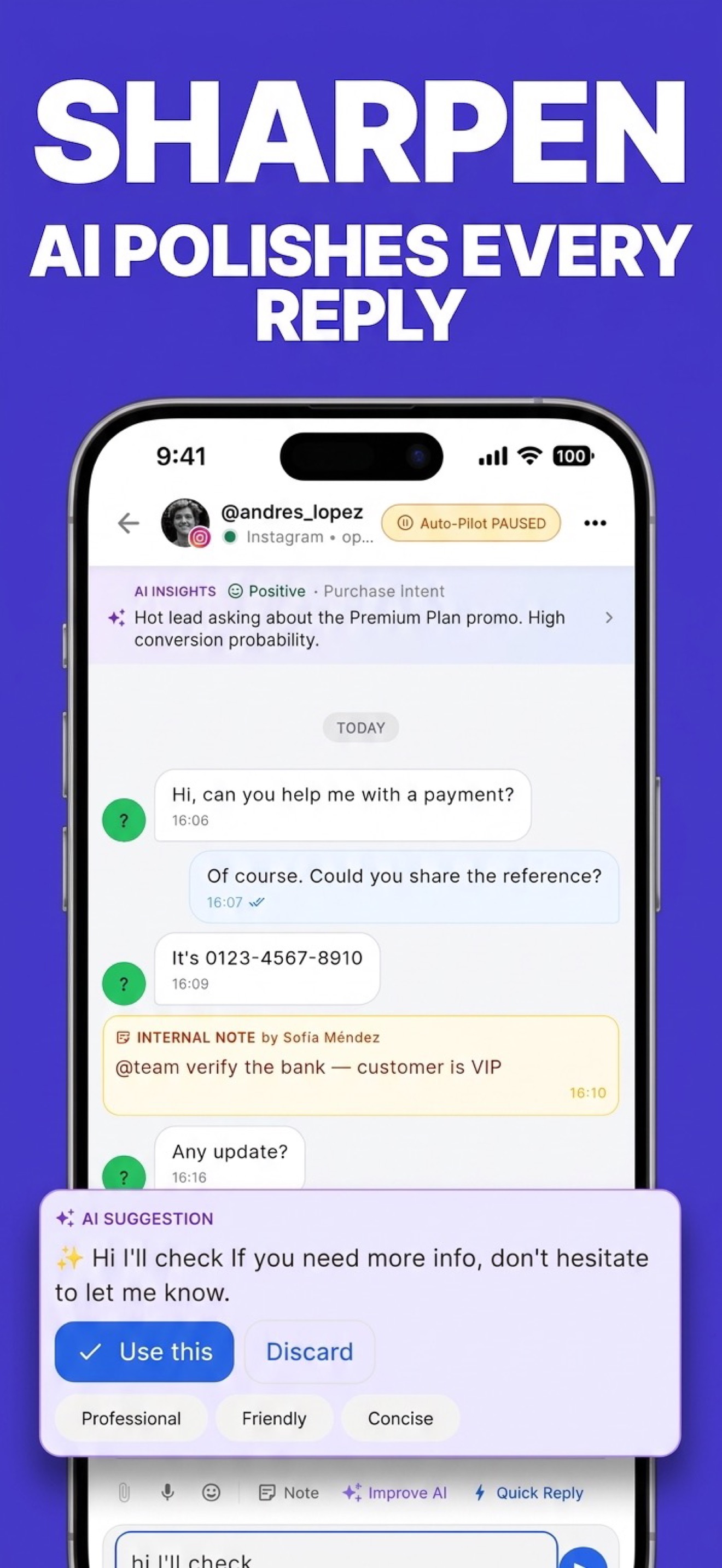
Omnichannel inbox with AI that prioritises, reads and replies
- Auto-Pilot ON: AI answers alone in your tone
- Sentiment and intent insights per conversation
- Reply suggestions with editable tones
- Push only when a human is needed


Your AI agent on WhatsApp, ready today
Connect your number, train the agent with your information and let it support and sell 24/7.
- Set up your AI agent
- WhatsApp + Voice + Payments integrated
- Human support when you need it
No commitment. Set up your AI agent today.

WhatsApp Bot
2,847 messages answered today
Reconciliation
€12,450 reconciled this week
Voice Agents
143 calls handled
Real-time data from Kharyo clients